
By Robert Pirsig
Published: 1991
I remember being almost 200 pages into this book and thinking about not finishing it. I had no idea what was going on and the style switched between the narrator’s inner voice (which up to this point had just been ramblings) and his description of the events happening to him. Over the next 200 pages, I remember putting the book down in amazement and thinking to myself “Wow… amazing… this is probably the best book I have ever read.”
Following up from his first book, The Zen and The Art of Motorcycle Maintenance, in which Pirsig concludes that quality cannot be defined. Lila is a semi-autobiographical story from the author attempting to answer this question as he travels by boat from New York to Florida. He picks up a young, attractive, and confused woman, named Lila which he uses as a metaphor for his framework to define quality.
The Metaphysics of Quality (MOQ)
First, he distinguishes quality into two main categories: static quality, which is long lasting and governing characteristics that bring order and predictability and dynamic quality, which are new ideas and out-of-the-box thinking, think of a new song that get stuck in our head, at first we listen repeatedly but over time the luster wears off. These two exist in contrast with one another, without dynamic quality, society cannot grow, but without static quality, it can not last.
Pirsig then dives deeper into static quality and provides a hierarchy that has helped to shape my understanding of why something is good and more clearly define what or why I like a certain thing, idea, or person. There are four elements within this hierarchy that build off one another and ultimately might rule out the other. In order from the bottom to the top:
- Inorganic (physical/matter): Laws of nature, in the case of Pirsig’s passenger, Lila, it is his male instinct that attracts him to someone of the opposite sex. In the case of a dish of food, it is our primal instinct that drives us to want to eat.
- Biological (life/nature): Desires built from our primal instincts often selfish in the form of lust, sex, power, etc. In the case of Lila, she has biological quality (she is attractive). This is also why we choose to eat certain things that might not be good for us or we know we shouldn’t.
- Social (patterns) (human/society): Ideas that govern groups of beings and or collective culturally accepted norms. This is where Lila begins to fall short as someone who has been cast out by society. In our everyday lives, we are often driven to liking something because of the herd mentality.
- Intellectual (mental): This is the pursuit for knowledge/truth and overall the quality of ideas. This is where Lila (like some girls that I have unsuccessfully dated) falls completely short, she is young and still has lots to learn. To me, this can also be specific to individuals, someone might have a lot of intellectual quality but it is nothing I am interested in nor can I relate to it. In a relationship, this type of quality often takes the longest to uncover but is the most important aspect of a relationship because this is where most of the time is actually spent. This could be a person, a job, or a hobby; I might be biologically attracted to the idea and society might validate it as a good thing but if it is not interesting to me, it will be difficult for me to invest a lot of time in it.
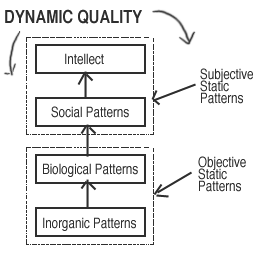
These four categories are exhaustive and everything that exists can be classified into one of these categories, that is except for dynamic quality, which also often trumps the four when it comes to identifying quality. This makes sense because there are often things that we like, yet can’t explain why except that it is new or fresh. This also gives an explanation of the idea of “grass being greener on the other side”.
This framework has served me well since finishing the book to help me understand why I like something and to give weight to my decisions. Whether it is a new relationship or a new job, I am often acknowledging the dynamic quality while also pursuing the intellectual quality (giving credence to the subordinate levels of quality as well).
I highly recommend reading this book, if you’re looking for a longer synopsis, this answer on Quora is a great overview: What is Robert Pirsig’s book, Lila, about?
I did eventually go back and read the prequel, Zen and The Art of Motorcycle Maintenance, which I also recommend. I have long been stumped on which might be better to read first. I probably would have enjoyed the first 200 pages of Lila more had I been familiar with Pirsig’s style, however, if you are only going to read one, definitely read Lila.
 Walfresh Consulting
Leave a comment