
By Robert Greene
Published 1998
This book was recommended to me by a co-worker and then re-recommended to me by that same co-worker repeatedly after several transgressions of the lessons highlighted in this work. Since then, there is no other book that I have lent out or bought for others more than Robert Greene’s 48 Laws of Power.
Often described as a Machiavellian bible or modern version of The Prince, Robert Greene focuses this book through the lens of power. Observing different tactics and techniques from power elites while working in Hollywood, he references his degree in classical studies to provide a guide for power based on stories of famous historical figures and strategists over the last 3,000 years. Each law has it’s own chapter, which provides a summary of the law, followed by a “transgression” (where someone went wrong), “observance” (effective use of the law), the “keys to power” (how to apply the law), and a “reversal” (situations where it might not apply). Each chapter also features additional stories, poems, or notes in the side columns related to the law.
I was reluctant to read the book because it seemed very cynical to me, some of the laws are cutthroat and downright sociopathic (“What do you mean I shouldn’t trust my friends? Why would I try to deceive people”). As I read through it I realized that this book serves as a shield rather than a spear, arming me against others trying to gain power over me. It can be uncomfortable, confusing, and disheartening to think about why people do what they do, yet by understanding the role that power plays, I am able to recognize possible intentions and act/respond accordingly.
If you are curious about all the laws, yet don’t have plans to read this dense 452-page masterpiece, I highly recommend spending 30 minutes watching this animated video:
The 48 Laws of Power (animated)

I watch this video at least once a quarter as a refresher.
I’d like to be clear that I don’t actively practice these laws, in fact amongst friends and close colleagues, I discourage them. In business settings, however, they can be very useful.
Here is a full list of all of the laws
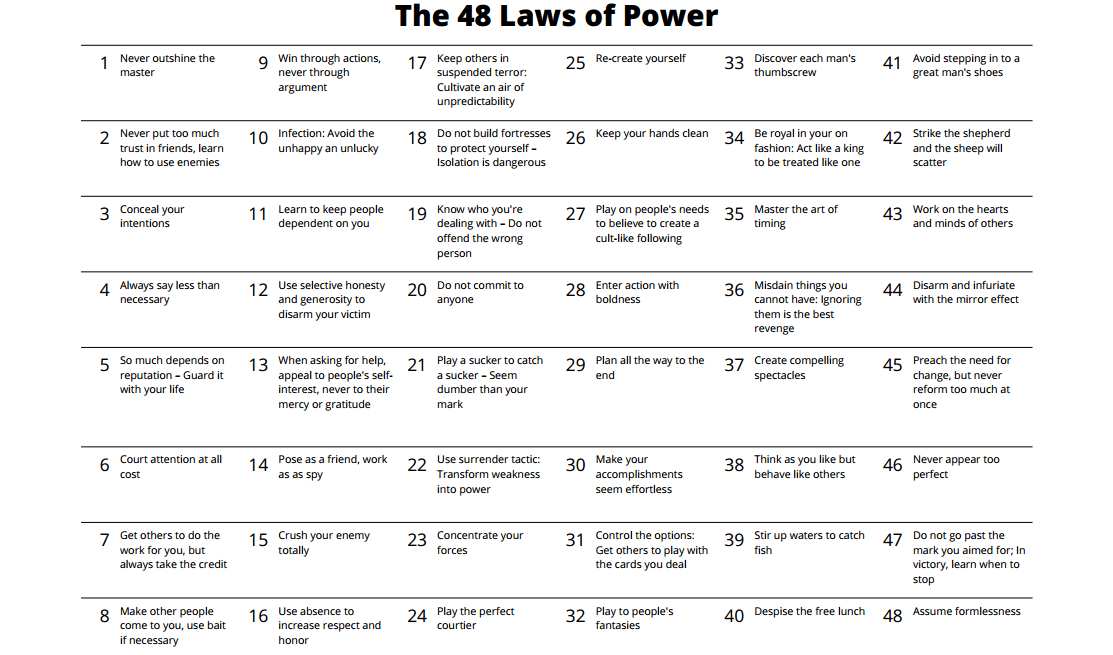
Some of my favorite laws that I would like to highlight:
- Law #1: Never Outshine Your Master – This is one that I struggled with early in my career as a young, hard-working, know-it-all millennial. I often privately criticised my managers and felt that I could do a better job than them. What I needed to realize is that by building them up, they would bring me with them and whether or not they knew I disliked their work, being against them would ensure they kept me down.
- Law #4: Always Say Less than Necessary – As someone who likes to talk and feels that I have a lot of insight to offer, this law was a realization for me that often I can say more by speaking less. As someone who is also often frustrated with people being vague and not providing enough information, this gave me some clarity behind why they might be doing that and a better approach as to how to deal with it.
- Law #9: Win Through Your Actions, Never Through Argument – Building off law #4, the best way to get someone to agree with you is not through your rhetoric or reasoning but instead your demonstrations. As someone who enjoys a good debate, I realized that for others that I was engaging with, even if I won them over, they often harbored negative feelings over the long run.
- Law #13: When Asking for Help, Appeal to People’s Self Interest, Never to Their Mercy or Gratitude – This is a good lesson in empathy, most good-natured people are willing to help you but often they won’t make it a priority and this can lead to frustration on both sides. By finding ways in which both parties can benefit, things will often get done more quickly and with a better sense of collaboration.
- Law #22: Use the Surrender Tactic: Transform Weakness into Power – Sometimes you have to be smart enough to recognize an un-winnable situation and in these cases, giving yourself time to recover, while also removing the satisfaction of victory from the other party will prove more effective in the long run.
- Law #28: Enter Action with Boldness – Once you have made up your mind, commit to that decision and don’t look back, often a bias for action will lead you somewhere ahead of where you were. Additionally having doubts and second-guessing will often lead to hesitation and missteps.
- Law #30: Make Your Accomplishments Seem Effortless – Telling people how hard you have worked on something, or the time and effort spent to accomplish a task only degrades the final product of your results.
- Law #36: Disdain Things You Cannot Have: Ignoring them is the Best Revenge – So much time, energy, and thoughts are wasted on people and things that ultimately amount to nothing. We hold out hope that something will change to increase our favor when we are likely best served to forget about it and move on. Additionally, people often treat us less when they know they are desired, yet when they are not given that satisfaction, they seek to regain our interest.
- Law #45: Preach the Need for Change, but Never Reform Too Much At Once – As someone who often tries to be the agent of change, it is important to understand that people are creatures of habit and too much change can lead to discomfort and ill-will towards you.
- Law #46: Never Appear Too Perfect: People always like to root for the underdog and often a little humility or authenticity can go a long way in building trust. My favorite line from this law: “Envy creates silent armies”, think Regina George from Mean Girls.
I have found myself recommending this book more often recently to friends who recently started in new roles and are navigating existing bureaucracies. When interacting with new people and relationships, it is easy to get caught up in why a person might be acting a certain way or doing something that we feel is against us. While they may or not be doing it intentionally, this whole process can result in a lot of wasted thoughts and having a simple explanation and/or solution to provide your own rationale can help to avoid this thinking or come up with a way to deal with it.
If you have read this book or have questions or comments, please leave a note on this post.
 Walfresh Consulting
Leave a comment