Author: walfresh

  • The App Strikes Back: Leveraging AI with Purpose

    The App Strikes Back: Leveraging AI with Purpose

    How AI and Purpose-Built Models Could Break Through App Fatigue

    In the early days of smartphones, apps were a novelty. There was an app for everything, from tracking your steps to turning your phone into a flashlight. However, as hardware became more capable and business models clearer, operating systems have incorporated these functions over time. As the number of home screens on our phones grew from two or three to five or six, users began to favor more streamlined, web-based solutions instead. This phenomenon, known as app fatigue, highlights the limits of the current app ecosystem, where the question, “Why do I need to download an app for this?” often arises. On our computers, where we have access to those web-based solutions, we are bogged down switching and populating information between different systems, and find ourselves asking, “Why can’t this be automated?” With highly capable large language models and a new wave of AI-enabled hardware coming this year, innovation is poised to rejuvenate the app ecosystem.

    The first question to always ask: Do I need to build an app?

    During Covid, some friends of mine built a successful business and brand for stock tank pools. They made it easy to set up, added a heating/cooling system, a custom top, and built a strong brand that in Texas is now synonymous with circular metal tanks. As they continue to grow (now shipping nationwide), they need to build a more defensible business. Building an app that could help control and maintain the pool, enable future functionality, and build a network for referrals and community could be an option. However, building an application would require them to hire/contract expensive engineering resources, and in this case, the value created likely wouldn’t justify the required investment. The best bet, and what they’ve started doing, is implementing software on the device (in this case, the heating/cooling system) that allows them to interact with smart home hubs like Amazon Echo, Apple HomeKit, and Google Home while also enabling integration with other devices in the future. The other benefits (network, maintenance, community, etc.) can all be achieved through their website.

    The technology isn’t what makes you unique, it is the value to users

    Another friend of mine started a company five years ago targeting one of the most time-consuming tasks in real estate – generating property descriptions. They built a model that leveraged available structured data combined with unstructured images and geographic variables, outputting descriptions at scale that could be reviewed rather than written. By building in feedback mechanisms into this time-saving process, they increased their confidence while collecting more data from their customers who were getting value from the product. They developed a specialization in understanding real estate documentation and started to build additional workflows. However, as they focused more on the technology differentiation, they became more of a feature and ultimately were acquired by their largest customer. For a startup, this isn’t a bad outcome. They created so much value for a particular segment that one company saw owning the technology outright as a differentiator.

    For companies that have an established product and customer base, the challenge is continued innovation, or put another way, avoiding disruption. AI is making it easier than ever to build and iterate on ideas. What took my friend’s real estate technology company months to build just a couple of years ago could likely have a working POC in a matter of weeks.

    Good ideas still need data

    The ability to process (and availability of) large amounts of data that could train these large language models was the breakthrough that led to the ChatGPT moment we experienced at the end of 2022. While these models boast broad knowledge, they are expensive to run and still cannot be fully relied on to perform tasks. Instead, they provide immense value as assistants. This is where the need arises for specialized models shaped by specific data sets and more efficient to run, becoming “expert” assistants. This opens doors for companies to highlight their unique insights and capabilities within niche domains. The head of AI for a large private equity firm summed this up nicely, saying, “Data is the differentiator, AI is the enabler.”

    To be clear, data isn’t your strategic advantage. There is so much data available on the Internet that no matter how good a dataset you have, the quantity of publicly available data makes it challenging to provide differentiated value with a smaller high-quality dataset.

    An organization’s data is more valuable to them than anyone else

    To highlight this point, there is a reason there is no established marketplace for data. Companies like AWS and HuggingFace do have data exchanges where one can find (and in some cases purchase) a dataset, but it isn’t a huge market. Data is still contextual and without the context of a system (usually the one it is captured in), it is a lot of numbers and letters. In most cases, extensive work is still needed to introduce new data through data cleaning and transformations.

    It’s important to understand this fallacy companies (and governments) fall into with their data and the perceived value they believe it has. The way that one differentiates is what they do with their data. You’ve got user data that is likely only valuable to you, but when adding in additional metadata and/or combined with other datasets, it can create a unique and differentiated offering. It’s not just the data; it’s how you use that data. Every company has data that could benefit from AI and provide value to their company. That data itself just isn’t that valuable.

    Apps as APIs for (L)LMs (LOCAL Language Models)

    Application data (whether that be security, networking, a calendar/task, or messages) is currently siloed within an operating system, and often a lot of the context is lost once it leaves the application it originated in. As the operating systems continue to evolve, LLMs will enable the capability to drive more interoperability. Some examples of what this might look like in current/future state app ecosystems:

    • I recently deleted Ticketmaster (and other ticketing apps like Eventbrite) from my phone because I can usually access what I need by going directly to the web (or downloading the app again the day of the show if I was forced to). But I would redownload it if the operating system knew what I liked/listened to and let me know if a particular artist/show I liked was coming to town (which in the past couple of years has expanded from primarily music concerts to comedy shows, Broadway musicals, Disney on Ice, and seasonal experiences). It would also be valuable to surface my tickets when I got to the venue (rather than making me do another password reset while I’m at the front of the line).
      • Spotify (probably my most used app) actually does this in reverse, starting with the music I listen to and then recommending tickets and merch from artists.
    • I might actually download a “City of Austin” app if it could provide data, ask questions, and make requests through an AI assistant.
    • Workflow and record management systems like Salesforce might actually be valuable if an AI assistant could surface relevant information about a record ahead of a meeting I have scheduled in my calendar and update the record in some way post-interaction.

    AI at the OS

    One thing that has become evident over the past couple of weeks is that AI will most commonly be adopted at the operating system level (rather than the model itself).

    • This trend started at NVIDIA’s GTC conference this past March, where CEO Jensen Huang laid out a vision for their integrated management system (NIMS). One large model (NIMS) sits on top and directs/schedules resources to more specialized models underneath it and then determines whether the output/result is satisfactory for the broader request.
    • While Meta has a limited operating system, they announced their free “Meta AI” assistant, which has all but replaced search within their applications.
    • Google, at their I/O conference, showcased a number of AI-powered features within their Workspace, Android, and Chrome operating systems. By having context of your calendar, your inbox, and the general user interface, you can get suggestions and accelerate your existing workflows to be more efficient.
    • Microsoft’s Build conference was all about “Copilot,” which is an operating system that works across an enterprise providing stable APIs for developers, seamless integration into a company’s existing applications and data, and with their Copilot PCs, enablement for users on their local devices.
    • Apple Intelligence will focus on specific use cases that leverage their strength as an integrated provider of hardware. On the surface, the capabilities seem to be evolutionary to anticipated actions (like Apple Maps always trying to guess where I’m going when I get in my car based on time of day). But these are functions that will enhance the experience and actually be used. Notably for developers, they will have access to an “App Intents Toolbox,” which will allow them to define actions to the operating system.

    All of these announcements diminish the value of the user interface of a specific application (which was already happening with “App Fatigue”) and stress the importance of having differentiated resources.

    The race to becoming an AI Aggregator

    Ahead of the Apple WWDC, many were expecting OpenAI to essentially replace Siri, but ChatGPT wasn’t even mentioned until the final five minutes of the presentation. When Apple Intelligence can’t fulfill a request, a prompt to ask ChatGPT will pop up. I anticipate other third-party models to become available, giving users a choice of model provider just like they have with browsers. It is easy to see how this could evolve (or revolve?) to applications more broadly.

    While Microsoft and Google were originally focused on having the best model, AWS’s strategy was (and has always been) to provide the right tool for the job (specifically for builders). For the majority of use cases, the “best” model isn’t always the most logical. We’ve seen both of the other hyperscalers shift to offering a choice because, at the end of the day, whether you’re using a managed service, a particular LLM, or running your open-source model, all roads will lead back to the cloud. Ultimately, what is important to them is where the data is stored and applications are built. The analogy I often use to explain what AWS does is “building your house on the internet,” and they are the Home Depot/Lowes. A builder can buy a shed or build one, add in all the plumbing or have a specialist do it, and on and on. Hyperscalers like AWS, Microsoft, and Google benefit from the scale of their users and can provide some differentiation in what they offer.

    Going back to my hardware store example, when I wanted to purchase a wood-pellet grill, the brand I was familiar with was Traeger, which was only available at Home Depot (like OpenAI is only available through Microsoft), but I ended up purchasing a Pit Boss from Lowe’s (which was closer) that provided the same utility (which would be like Anthropic on AWS).

    If it’s all back to cloud and large LLMs, what’s left?

    When IBM first invented computers, the prediction was that there would only be five computers in the whole world. What we’ve seen is a wide range of computers, from hyperscaler data centers all the way down to small chips heating and cooling devices for a pool. A big driver of this was the introduction of the Windows operating system that made computers more accessible through a windows, icons, mouse, and pointer interface. Apple came along and made computing even more ubiquitous with pocket-sized devices that minimized the need for a mouse and windows with finger gestures. Google introduced the search bar, which is gradually phasing out icons.

    Just like computers, the future of AI will come in all shapes and sizes and different functionality. In another post, I might dive into why AI isn’t going to take over the world, but to keep it brief: Humans are and will always be the agents making decisions. AI and other technology that has come before only accelerate the time to make the next decision. There will always need to be a human in the loop as “the pointer” to the next action needed (even if that is just reviewing/approving suggested actions from an AI). Microsoft held on to their WIMP interface for too long. They saw the mobile revolution as devices that were an extension of your PC that you could take everywhere. Mobile (and search that followed) was much more about the everywhere part than the PC.

    It is this everywhere point that is important to keep in mind. There certainly will be a need for the large language models that we see today that know a lot of things about everything, but as we move forward, there is a need for models that know everything about ONE thing. These models will give users the confidence needed to make the next decision in their workflows.

    AI can make it possible for an application to do anything, but for organizations looking to build something, it is the “thing” that matters. Rather than thinking about how AI can replace these things, focusing on the human doing the things and how your app can augment will be the key to innovation and sustained success.

    So I should build an app?

    Rather than asking, “Should I build an app for that?”, some better questions to ask might be:

    • What is the decision point I’m trying to accelerate?
    • Why would a human want an answer from me and not Google or ChatGPT?
    • What data is there (or could be collected) that will differentiate the experience?

    If you’re interested in leveraging AI within your organization and want to talk more specifically about what you’re doing, I’d love to help you. Please don’t hesitate to reach out, and we can set up some time to chat.

  • How I Discovered Yoga and Why I Do It Everyday

    How I Discovered Yoga and Why I Do It Everyday

    For me, yoga started as a fitness activity. Every week, I had a two different workout routines I would do which I would break up with one or two yoga classes in between. A couple of events over the course of 2018 is what led me deeper into the practice, ritual, and attitude of yoga.

    When the year began I was halfway through Leadership Austin’s Emerge program. The training was focused on understanding and exemplifying your values. Identifying my personal values was further cemented by the book I was reading, “The Subtle Art of Not Giving a F***”, by Mark Manson (Great read btw, highly recommend to anyone and everyone). I clearly identified my values into the three categories that are the theme of this site:

    • Self – what am I doing to make myself better
    • Service – what am I doing to serve others and the world around me
    • Social – deepening relationships and spending quality time with others (I’m an extrovert)

    On March 19th I turned thirty years old and anyone who tells you that things don’t change at milestone birthdays has either already changed or might never change. When there is a new number in front of your age, you think differently. The high of my birthday was quickly numbed when I was faced with a tough decision and left one of my main areas of service, my job of the last one a half years.

    This brought my values to the forefront. To ensure that they stayed there, I began keeping a daily catalogue of activities in each category. This exercise self-awareness led me to eating a better diet, riding my bike more often and attending more yoga classes. Through the extreme kindness of a friend and possibly some divine intervention, I was gifted a membership at a local studio where I quickly realized that yoga was not just a fitness activity that grouped into my “self” improvement bucket each night, it was a special thing that fit into every bucket.

    Every day I would ride my bike to a class that my friend was teaching. This not only gave me a chance to see her but through the practice of dedication that comes with yoga, also felt as if I was supporting her. She soon began to introduce me to others in the studio and feel welcome in the community. Trusting in the positive feelings it provided me, I am now taking the next step doing teacher training with 20+ other yogi’s that are as interested in their practice as me. Is Yoga a social activity for me? Mmhmm.

    While it was nice having a flexible schedule, there was a lot of stress and discomfort that came with looking for new opportunities. In the beginning, I was beaten down and began to surround myself with unnecessary negative talk. There was a significant improvement in my success pursuing my value of service tied the distinct time I started practicing every day. By September, I had three unique and promising opportunities and eventually decided to join one of the top technology companies in a sales role that I had always desired. It’s hard for me to deny that one didn’t influence the other, practicing every day provided me with stress relief and allowed me to realign my mindset.

    While Yoga has always been a physical activity to improve my health, CorePower workouts embody everything that I want in a workout; cardio, strength training, and cool down/reflection, all while getting a really good sweat in. Yoga is also more than something you do, similar to snowboarding (one of my other all-time favorite activities), it is something that you can get better at. Contrary to other sports, my experience is that the better you get at yoga, the harder it gets. Every time I feel as though I am plateauing, I make a slight adjustment here or a breakthrough somewhere else and am humbled to feeling novice again. Participating in a class with others and an amazing teacher also motivates you to work harder. I am in the best shape of my life and feel more optimistic about my long-term health thanks to yoga.

    For me Yoga is an activity that fuels the most important aspects of my life and has led me significant joy.

  • My First Marketing Plan

    My First Marketing Plan

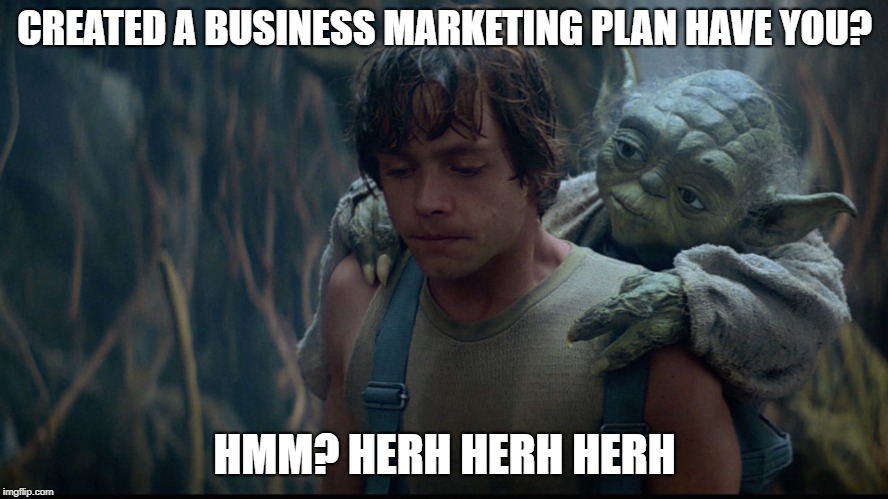
    “Have you created a business marketing plan?” my favorite business school teacher asked me. “No, not yet, I was kind of hoping…” but before I could finish he cut me off.

    Look if you haven’t created a business marketing plan, there probably isn’t too much I can help you with. 

    I was a little taken aback, this was my favorite teacher, we had a great relationship and often joked around with one another, I couldn’t understand why he was being so cold. In retrospect, this was one of his final lessons. This was the point when I realized I was in the real world and needed to put my big boy pants on. He went on to make the point that while he knew a lot about marketing, he wasn’t familiar with the industry that I was in or what resources I had (frankly I didn’t really either). If I wasn’t going to use the basic knowledge and skills they had already taught me, I didn’t deserve their advanced opinions.

    Business marketing plan jedi meme

    This was my first job out of college, working in the solar industry. Surprisingly when I went back and built my own business marketing plan, the ideas I was seeking began to flow out of me. This is now something that I routinely ask people for and if it doesn’t exist, often make it a priority to create. Everyone often feelsBu that they know the ins and outs of their business but until you actually take the time to put things on paper (or in a document) are you really able to grasp the full picture.

    What goes into a business marketing plan?

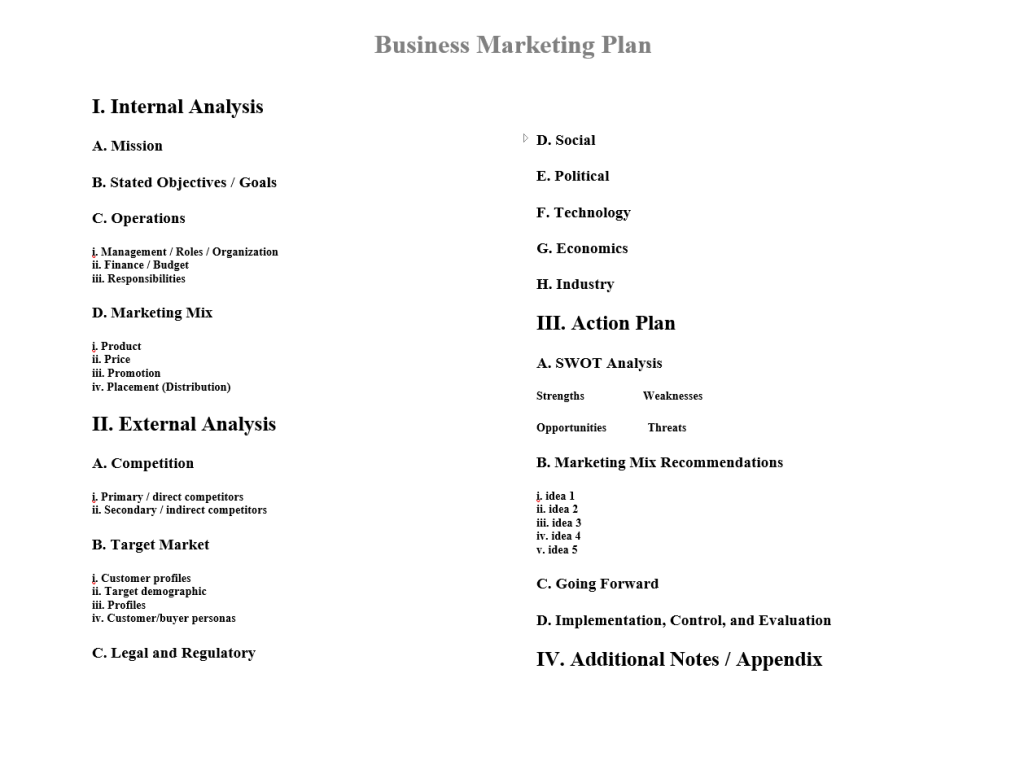
    A good plan is broken into two parts (i) analysis and (ii) actions. The analysis is further broken into two parts (i) internal and (ii) external. Here is an example outline for a business plan.

    Business Marketing Plan

    I. Internal Analysis

    A. Mission
    B. Stated Objectives / Goals
    C. Operations
    i. Management / Roles / Organization
    ii. Finance / Budget
    iii. Responsibilities
    D. Marketing Mix
    i. Product
    ii. Price
    iii. Promotion
    iv. Placement (Distribution)

    II. External Analysis

    A. Competition
    i. Primary / direct competitors
    ii. Secondary / indirect competitors
    B. Target Market
    i. Customer profiles
    ii. Target demographic
    iii. Profiles
    iv. Customer/buyer personas
    C. Legal and Regulatory
    D. Social
    E. Political
    F. Technology
    G. Economics
    H. Industry

    III. Action Plan

    A. SWOT Analysis
    Strengths                    Weaknesses
    Opportunities              Threats
    B. Marketing Mix Recommendations
    i. idea 1
    ii. idea 2
    iii. idea 3
    iv. idea 4
    v. idea 5
    C. Going Forward
    D. Implementation, Control, and Evaluation

    IV. Additional Notes / Appendix

    Example Marketing Plan

    Here is a link to view a draft of one of the first marketing plans I created in 2012. My more recent plans have a lot more detail and are much more refined. I am releasing this plan because it brought a great deal of success and enough time has passed that I am not compromising any business activity.

    Note: Some information has been removed but it should provide a general idea.

    Google Docs: Business Marketing Plan

    Word Doc Download: Business Marketing Plan

  • My Favorite Books – 48 Laws of Power

    My Favorite Books – 48 Laws of Power

    By Robert Greene
    Published 1998 

    This book was recommended to me by a co-worker and then re-recommended to me by that same co-worker repeatedly after several transgressions of the lessons highlighted in this work. Since then, there is no other book that I have lent out or bought for others more than Robert Greene’s 48 Laws of Power.

    Often described as a Machiavellian bible or modern version of The Prince, Robert Greene focuses this book through the lens of power. Observing different tactics and techniques from power elites while working in Hollywood, he references his degree in classical studies to provide a guide for power based on stories of famous historical figures and strategists over the last 3,000 years. Each law has it’s own chapter, which provides a summary of the law, followed by a “transgression” (where someone went wrong), “observance” (effective use of the law), the “keys to power” (how to apply the law), and a “reversal” (situations where it might not apply). Each chapter also features additional stories, poems, or notes in the side columns related to the law.

    I was reluctant to read the book because it seemed very cynical to me, some of the laws are cutthroat and downright sociopathic (“What do you mean I shouldn’t trust my friends? Why would I try to deceive people”). As I read through it I realized that this book serves as a shield rather than a spear, arming me against others trying to gain power over me. It can be uncomfortable, confusing, and disheartening to think about why people do what they do, yet by understanding the role that power plays, I am able to recognize possible intentions and act/respond accordingly.

    If you are curious about all the laws, yet don’t have plans to read this dense 452-page masterpiece, I highly recommend spending 30 minutes watching this animated video:

    The 48 Laws of Power (animated)
    48 Laws Animated video cover

    I watch this video at least once a quarter as a refresher.

    I’d like to be clear that I don’t actively practice these laws, in fact amongst friends and close colleagues, I discourage them. In business settings, however, they can be very useful.

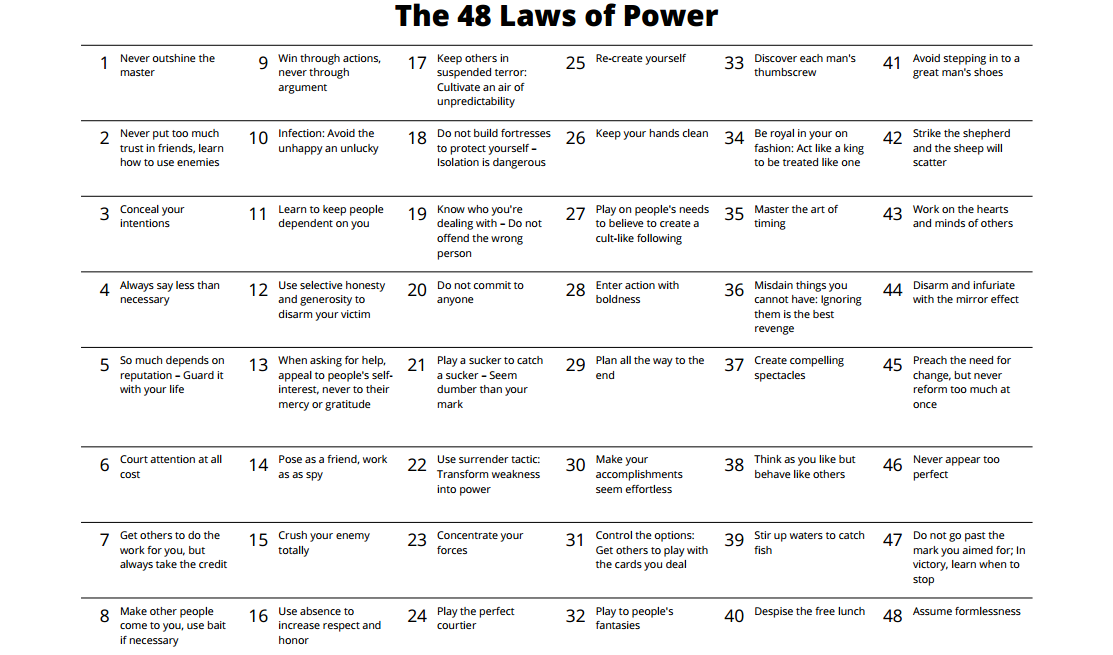
    Here is a full list of all of the laws
    48 Laws of Power

    Some of my favorite laws that I would like to highlight:

    • Law #1: Never Outshine Your Master – This is one that I struggled with early in my career as a young, hard-working, know-it-all millennial. I often privately criticised my managers and felt that I could do a better job than them. What I needed to realize is that by building them up, they would bring me with them and whether or not they knew I disliked their work, being against them would ensure they kept me down.
    • Law #4: Always Say Less than Necessary – As someone who likes to talk and feels that I have a lot of insight to offer, this law was a realization for me that often I can say more by speaking less. As someone who is also often frustrated with people being vague and not providing enough information, this gave me some clarity behind why they might be doing that and a better approach as to how to deal with it.
    • Law #9: Win Through Your Actions, Never Through Argument – Building off law #4, the best way to get someone to agree with you is not through your rhetoric or reasoning but instead your demonstrations. As someone who enjoys a good debate, I realized that for others that I was engaging with, even if I won them over, they often harbored negative feelings over the long run.
    • Law #13: When Asking for Help, Appeal to People’s Self Interest, Never to Their Mercy or Gratitude – This is a good lesson in empathy, most good-natured people are willing to help you but often they won’t make it a priority and this can lead to frustration on both sides. By finding ways in which both parties can benefit, things will often get done more quickly and with a better sense of collaboration.
    • Law #22: Use the Surrender Tactic: Transform Weakness into Power – Sometimes you have to be smart enough to recognize an un-winnable situation and in these cases, giving yourself time to recover, while also removing the satisfaction of victory from the other party will prove more effective in the long run.
    • Law #28: Enter Action with Boldness – Once you have made up your mind, commit to that decision and don’t look back, often a bias for action will lead you somewhere ahead of where you were. Additionally having doubts and second-guessing will often lead to hesitation and missteps.
    • Law #30: Make Your Accomplishments Seem Effortless – Telling people how hard you have worked on something, or the time and effort spent to accomplish a task only degrades the final product of your results.
    • Law #36: Disdain Things You Cannot Have: Ignoring them is the Best Revenge – So much time, energy, and thoughts are wasted on people and things that ultimately amount to nothing. We hold out hope that something will change to increase our favor when we are likely best served to forget about it and move on. Additionally, people often treat us less when they know they are desired, yet when they are not given that satisfaction, they seek to regain our interest.
    • Law #45: Preach the Need for Change, but Never Reform Too Much At Once – As someone who often tries to be the agent of change, it is important to understand that people are creatures of habit and too much change can lead to discomfort and ill-will towards you.
    • Law #46: Never Appear Too Perfect: People always like to root for the underdog and often a little humility or authenticity can go a long way in building trust. My favorite line from this law: “Envy creates silent armies”, think Regina George from Mean Girls.

    I have found myself recommending this book more often recently to friends who recently started in new roles and are navigating existing bureaucracies. When interacting with new people and relationships, it is easy to get caught up in why a person might be acting a certain way or doing something that we feel is against us. While they may or not be doing it intentionally, this whole process can result in a lot of wasted thoughts and having a simple explanation and/or solution to provide your own rationale can help to avoid this thinking or come up with a way to deal with it.

    If you have read this book or have questions or comments, please leave a note on this post.

  • My Favorite Books – Lila, an Inquiry into Morals

    My Favorite Books – Lila, an Inquiry into Morals

    By Robert Pirsig
    Published: 1991

    I remember being almost 200 pages into this book and thinking about not finishing it. I had no idea what was going on and the style switched between the narrator’s inner voice (which up to this point had just been ramblings) and his description of the events happening to him. Over the next 200 pages, I remember putting the book down in amazement and thinking to myself “Wow… amazing… this is probably the best book I have ever read.”

    Following up from his first book, The Zen and The Art of Motorcycle Maintenance, in which Pirsig concludes that quality cannot be defined. Lila is a semi-autobiographical story from the author attempting to answer this question as he travels by boat from New York to Florida. He picks up a young, attractive, and confused woman, named Lila which he uses as a metaphor for his framework to define quality.

    The Metaphysics of Quality (MOQ)

    First, he distinguishes quality into two main categories: static quality, which is long lasting and governing characteristics that bring order and predictability and dynamic quality, which are new ideas and out-of-the-box thinking, think of a new song that get stuck in our head, at first we listen repeatedly but over time the luster wears off. These two exist in contrast with one another, without dynamic quality, society cannot grow, but without static quality, it can not last.

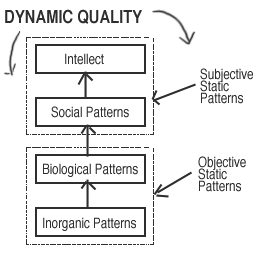
    Pirsig then dives deeper into static quality and provides a hierarchy that has helped to shape my understanding of why something is good and more clearly define what or why I like a certain thing, idea, or person. There are four elements within this hierarchy that build off one another and ultimately might rule out the other. In order from the bottom to the top:

    • Inorganic (physical/matter): Laws of nature, in the case of Pirsig’s passenger, Lila, it is his male instinct that attracts him to someone of the opposite sex. In the case of a dish of food, it is our primal instinct that drives us to want to eat.
    • Biological (life/nature): Desires built from our primal instincts often selfish in the form of lust, sex, power, etc. In the case of Lila, she has biological quality (she is attractive). This is also why we choose to eat certain things that might not be good for us or we know we shouldn’t.
    • Social (patterns) (human/society): Ideas that govern groups of beings and or collective culturally accepted norms. This is where Lila begins to fall short as someone who has been cast out by society. In our everyday lives, we are often driven to liking something because of the herd mentality.
    • Intellectual (mental): This is the pursuit for knowledge/truth and overall the quality of ideas. This is where Lila (like some girls that I have unsuccessfully dated) falls completely short, she is young and still has lots to learn. To me, this can also be specific to individuals, someone might have a lot of intellectual quality but it is nothing I am interested in nor can I relate to it. In a relationship, this type of quality often takes the longest to uncover but is the most important aspect of a relationship because this is where most of the time is actually spent. This could be a person, a job, or a hobby; I might be biologically attracted to the idea and society might validate it as a good thing but if it is not interesting to me, it will be difficult for me to invest a lot of time in it.

    MOQ explained

    These four categories are exhaustive and everything that exists can be classified into one of these categories, that is except for dynamic quality, which also often trumps the four when it comes to identifying quality. This makes sense because there are often things that we like, yet can’t explain why except that it is new or fresh. This also gives an explanation of the idea of “grass being greener on the other side”.

    This framework has served me well since finishing the book to help me understand why I like something and to give weight to my decisions. Whether it is a new relationship or a new job, I am often acknowledging the dynamic quality while also pursuing the intellectual quality (giving credence to the subordinate levels of quality as well).

    I highly recommend reading this book, if you’re looking for a longer synopsis, this answer on Quora is a great overview: What is Robert Pirsig’s book, Lila, about?

    I did eventually go back and read the prequel, Zen and The Art of Motorcycle Maintenance, which I also recommend. I have long been stumped on which might be better to read first. I probably would have enjoyed the first 200 pages of Lila more had I been familiar with Pirsig’s style, however, if you are only going to read one, definitely read Lila.