
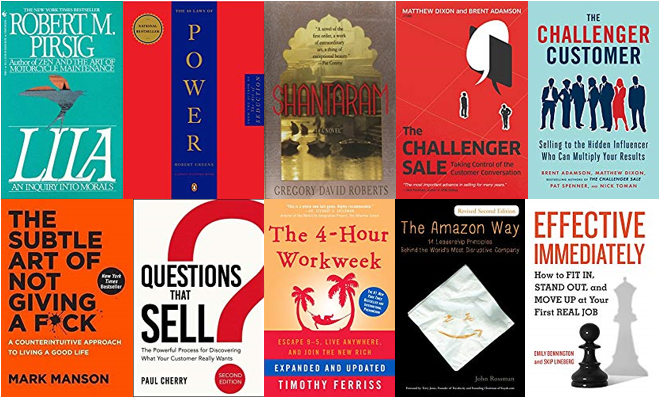
I was trying to think about how many books I have read in my life and the answer is I really don’t know. I do know which ones have made an impact on me and that I recommend most often. Below is a list of the books with links and descriptions, for some books I have created separate blog posts with more detailed descriptions and the impact that they had on me.
Lila: An Inquiry into Morals
Robert Pirsig (1991)


In this bestselling new book, his first in seventeen years, Robert M. Pirsig, author of Zen and the Art of Motorcycle Maintenance, takes us on a poignant and passionate journey as mysterious and compelling as his first life-changing work.
Instead of a motorcycle, a sailboat carries his philosopher-narrator Phaedrus down the Hudson River as winter closes in. Along the way he picks up a most unlikely traveling companion: a woman named Lila who in her desperate sexuality, hostility, and oncoming madness threatens to disrupt his life.
In Lila Robert M. Pirsig has crafted a unique work of adventure and ideas that examines the essential issues of the nineties as his previous classic did the seventies.
Read my full blog post about this book
48 Laws of Power
Robert Greene (1998)


Amoral, cunning, ruthless, and instructive, this New York Times bestseller is the definitive manual for anyone interested in gaining, observing, or defending against ultimate control.
In the book that People magazine proclaimed “beguiling” and “fascinating,” Robert Greene and Joost Elffers have distilled three thousand years of the history of power into 48 essential laws by drawing from the philosophies of Machiavelli, Sun Tzu, and Carl Von Clausewitz and also from the lives of figures ranging from Henry Kissinger to P.T. Barnum.
Some laws teach the need for prudence (“Law 1: Never Outshine the Master”), others teach the value of confidence (“Law 28: Enter Action with Boldness”), and many recommend absolute self-preservation (“Law 15: Crush Your Enemy Totally”). Every law, though, has one thing in common: an interest in total domination. In a bold and arresting two-color package, The 48 Laws of Power is ideal whether your aim is conquest, self-defense, or simply to understand the rules of the game.
Read my full blog post about this book
Shantaram
Gregory David Roberts (2003)


“It took me a long time and most of the world to learn what I know about love and fate and the choices we make, but the heart of it came to me in an instant, while I was chained to a wall and being tortured.”
So begins this epic, mesmerizing first novel set in the underworld of contemporary Bombay. Shantaramis narrated by Lin, an escaped convict with a false passport who flees maximum security prison in Australia for the teeming streets of a city where he can disappear.
Accompanied by his guide and faithful friend, Prabaker, the two enter Bombay’s hidden society of beggars and gangsters, prostitutes and holy men, soldiers and actors, and Indians and exiles from other countries, who seek in this remarkable place what they cannot find elsewhere.
As a hunted man without a home, family, or identity, Lin searches for love and meaning while running a clinic in one of the city’s poorest slums, and serving his apprenticeship in the dark arts of the Bombay mafia. The search leads him to war, prison torture, murder, and a series of enigmatic and bloody betrayals. The keys to unlock the mysteries and intrigues that bind Lin are held by two people. The first is Khader Khan: mafia godfather, criminal-philosopher-saint, and mentor to Lin in the underworld of the Golden City. The second is Karla: elusive, dangerous, and beautiful, whose passions are driven by secrets that torment her and yet give her a terrible power.
Burning slums and five-star hotels, romantic love and prison agonies, criminal wars and Bollywood films, spiritual gurus and mujaheddin guerrillas—this huge novel has the world of human experience in its reach, and a passionate love for India at its heart. Based on the life of the author, it is by any measure the debut of an extraordinary voice in literature.
The Challenger Sale / The Challenger Customer
Brent Adamson & Matthew Dixon (2011/2015)


What’s the secret to sales success? If you’re like most business leaders, you’d say it’s fundamentally about relationships-and you’d be wrong. The best salespeople don’t just build relationships with customers. They challenge them.
The need to understand what top-performing reps are doing that their average performing colleagues are not drove Matthew Dixon, Brent Adamson, and their colleagues at Corporate Executive Board to investigate the skills, behaviors, knowledge, and attitudes that matter most for high performance. And what they discovered may be the biggest shock to conventional sales wisdom in decades.
Based on an exhaustive study of thousands of sales reps across multiple industries and geographies, The Challenger Sale argues that classic relationship building is a losing approach, especially when it comes to selling complex, large-scale business-to-business solutions. The authors’ study found that every sales rep in the world falls into one of five distinct profiles, and while all of these types of reps can deliver average sales performance, only one-the Challenger- delivers consistently high performance.
Instead of bludgeoning customers with endless facts and features about their company and products, Challengers approach customers with unique insights about how they can save or make money. They tailor their sales message to the customer’s specific needs and objectives. Rather than acquiescing to the customer’s every demand or objection, they are assertive, pushing back when necessary and taking control of the sale.
The things that make Challengers unique are replicable and teachable to the average sales rep. Once you understand how to identify the Challengers in your organization, you can model their approach and embed it throughout your sales force. The authors explain how almost any average-performing rep, once equipped with the right tools, can successfully reframe customers’ expectations and deliver a distinctive purchase experience that drives higher levels of customer loyalty and, ultimately, greater growth.


Four years ago, the bestselling authors of The Challenger Sale overturned decades of conventional wisdom with a bold new approach to sales. Now their latest research reveals something even more surprising: Being a Challenger seller isn’t enough. Your success or failure also depends on who you challenge.
Picture your ideal customer: friendly, eager to meet, ready to coach you through the sale and champion your products and services across the organization. It turns out that’s the last person you need.
Most marketing and sales teams go after low-hanging fruit: buyers who are eager and have clearly articulated needs. That’s simply human nature; it’s much easier to build a relationship with someone who always makes time for you, engages with your content, and listens attentively. But according to brand-new CEB research—based on data from thousands of B2B marketers, sellers, and buyers around the world—the highest-performing teams focus their time on potential customers who are far more skeptical, far less interested in meeting, and ultimately agnostic as to who wins the deal. How could this be?
The authors of The Challenger Customer reveal that high-performing B2B teams grasp something that their average-performing peers don’t: Now that big, complex deals increasingly require consensus among a wide range of players across the organization, the limiting factor is rarely the salesperson’s inability to get an individual stakeholder to agree to a solution. More often it’s that the stakeholders inside the company can’t even agree with one another about what the problem is.
It turns out only a very specific type of customer stakeholder has the credibility, persuasive skill, and will to effectively challenge his or her colleagues to pursue anything more ambitious than the status quo. These customers get deals to the finish line far more often than friendlier stakeholders who seem so receptive at first. In other words, Challenger sellers do best when they target Challenger customers.
The Challenger Customer unveils research-based tools that will help you distinguish the “Talkers” from the “Mobilizers” in any organization. It also provides a blueprint for finding them, engaging them with disruptive insight, and equipping them to effectively challenge their own organization.
The Subtle Art of Not Giving a F***
Mark Manson (2016)


In this generation-defining self-help guide, a superstar blogger cuts through the crap to show us how to stop trying to be “positive” all the time so that we can truly become better, happier people.
For decades, we’ve been told that positive thinking is the key to a happy, rich life. “F**k positivity,” Mark Manson says. “Let’s be honest, shit is f**ked and we have to live with it.” In his wildly popular Internet blog, Manson doesn’t sugarcoat or equivocate. He tells it like it is—a dose of raw, refreshing, honest truth that is sorely lacking today. The Subtle Art of Not Giving a F**k is his antidote to the coddling, let’s-all-feel-good mindset that has infected modern society and spoiled a generation, rewarding them with gold medals just for showing up.
Manson makes the argument, backed both by academic research and well-timed poop jokes, that improving our lives hinges not on our ability to turn lemons into lemonade, but on learning to stomach lemons better. Human beings are flawed and limited—”not everybody can be extraordinary, there are winners and losers in society, and some of it is not fair or your fault.” Manson advises us to get to know our limitations and accept them. Once we embrace our fears, faults, and uncertainties, once we stop running and avoiding and start confronting painful truths, we can begin to find the courage, perseverance, honesty, responsibility, curiosity, and forgiveness we seek.
There are only so many things we can give a f**k about so we need to figure out which ones really matter, Manson makes clear. While money is nice, caring about what you do with your life is better, because true wealth is about experience. A much-needed grab-you-by-the-shoulders-and-look-you-in-the-eye moment of real-talk, filled with entertaining stories and profane, ruthless humor, The Subtle Art of Not Giving a F**k is a refreshing slap for a generation to help them lead contented, grounded lives.
Questions that Sell
Paul Cherry (2006)


Ask the questions-and get the sale. As a salesperson your product knowledge is extensive, but that’s not enough. If you fail to ask the right questions-the ones that uncover a customer’s real needs-you will never close the deal. Questions that Sell reveals advanced questioning techniques that will help you sell your products or services based on value to the customer, rather than price-and increase your success rate as a result. Packed with powerful examples, exercises, and hundreds of sample questions for a wide range of buyer interactions, the revised and updated second edition now includes new material on how to: Use questions to qualify prospects (without insulting them) * Discover hidden customer needs and motivations * Raise delicate questions * Overcome stalls * Reinvigorate a stale relationship * Soothe anxious buyers * Accelerate the decision process * Upsell and cross-sell so you no longer leave money on the table * Prospect for new business * Pose intriguing questions to position yourself as a thought-leader on social media * Turn social media contacts into active sales leads * Identify dead-end opportunities * Secure referrals * And more Success is yours for the asking. Smart questioning will get you there.
The Hunger Games Trilogy
Suzanne Collins (2008-2010)


From Book 1: The book no one can stop talking about . . . In the ruins of a place once known as North America lies the nation of Panem, a shining Capitol surrounded by twelve outlying districts. The Capitol is harsh and cruel and keeps the districts in line by forcing them all to send one boy and one girl between the ages of twelve and eighteen to participate in the annual Hunger Games, a fight to the death on live TV. Sixteen-year-old Katniss Everdeen, who lives alone with her mother and younger sister, regards it as a death sentence when she is forced to represent her district in the Games. But Katniss has been close to dead and survival, for her, is second nature. Without really meaning to, she becomes a contender. But if she is to win, she will have to start making choices that weigh survival against humanity and life against love. New York Times bestselling author Suzanne Collins delivers equal parts suspense and philosophy, adventure and romance, in this searing novel set in a future with unsettling parallels to our present.
The 4 Hour Work Week
Tim Ferriss (2009)


Forget the old concept of retirement and the rest of the deferred-life plan–there is no need to wait and every reason not to, especially in unpredictable economic times. Whether your dream is escaping the rat race, experiencing high-end world travel, or earning a monthly five-figure income with zero management, The 4-Hour Workweek is the blueprint.
This step-by-step guide to luxury lifestyle design teaches:
• How Tim went from $40,000 per year and 80 hours per week to $40,000 per month and 4 hours per week
• How to outsource your life to overseas virtual assistants for $5 per hour and do whatever you want
• How blue-chip escape artists travel the world without quitting their jobs
• How to eliminate 50% of your work in 48 hours using the principles of a forgotten Italian economist
• How to trade a long-haul career for short work bursts and frequent “mini-retirements”
The new expanded edition of Tim Ferriss’ The 4-Hour Workweek includes:
• More than 50 practical tips and case studies from readers (including families) who have doubled income, overcome common sticking points, and reinvented themselves using the original book as a starting point
• Real-world templates you can copy for eliminating e-mail, negotiating with bosses and clients, or getting a private chef for less than $8 a meal
• How Lifestyle Design principles can be suited to unpredictable economic times
• The latest tools and tricks, as well as high-tech shortcuts, for living like a diplomat or millionaire without being either
The Amazon Way
John Rossman (2016)


Interested in innovating and creating a customer focused culture like Amazon? In The Amazon Way, Rossman introduces readers to the unique corporate culture of the world’s largest Internet retailer, with a focus on the fourteen leadership principles that have guided and shaped its decisions and its distinctive leadership culture — as only an insider could do.
Peppered with humorous and enlightening firsthand anecdotes from the author’s career at Amazon, this revealing business guide is also filled with the valuable lessons that have served Jeff Bezos’s “everything store” so well—providing expert advice for aspiring entrepreneurs, CEOs, and investors alike.
In just twenty years, Amazon.com has gone from a start-up internet bookseller to a global company revolutionizing and disrupting multiple industries, including retail, publishing, logistics, devices, apparel, and cloud computing.
But what is at the heart of Amazon.com’s rise to success? Is it the tens of millions of items in stock, the company’s technological prowess, or the many customer service innovations like “one-click”?
As a leader at Amazon who had a front-row seat during its formative years, John Rossman understands the iconic company better than most. From the launch of Amazon’s third-party seller program to their foray into enterprise services, he witnessed it all—the amazing successes, the little-known failures, and the experiments whose outcomes are still in doubt.
7 Habits of Highly Effective People
Stephen Covey (1989)


One of the most inspiring and impactful books ever written, The 7 Habits of Highly Effective People has captivated readers for 25 years. It has transformed the lives of Presidents and CEOs, educators and parents— in short, millions of people of all ages and occupations.
Effective Immediately: How to Fit In, Stand Out, and Move Up at Your First Real Job
Emily Bennington (2010)

If you’re a recent college graduate or new hire, Effective Immediately shows you how to excel at your first job and jump-start your career. As an up-and-coming professional, you’ll learn how to transform yourself from entry-level employee into skilled, invaluable all-star during your first year on the job.
Accomplished young professional Emily Bennington and her mentor, seasoned manager Skip Lineberg, empower you to:
• Establish yourself as a top performer from day one
• Use every task—even grunt work—as an opportunity to shine
• Earn the respect of your boss, colleagues, and clients
• Cope with conflict, mistakes, and toxic coworkers
• Land key assignments and gain greater responsibility
• Manage projects and lead teams like a pro
Packed with practical advice, useful resources, and wisdom from former newbies, this savvy hand-book gives you the tools, knowledge, and confidence you need to reach your highest potential.
 Walfresh Consulting